
3 Best Proton VPN Alternatives in 2026: Free VPNs, NordVPN and the Best Paid Options
Looking for the best Proton VPN alternatives in 2026? Shieldway is our top alternative to Proton VPN for users who want a managed WireGuard desktop connection without running their own VPN server. Its free access requires ByteConnect bandwidth sharing, so users should understand this arrangement before getting started. Proton VPN remains our recommended baseline for those who want a free plan without that requirement, while NordVPN is worth considering for premium security features and Surfshark for paid-plan value across multiple devices. The best choice ultimately depends on your privacy priorities, budget, and the features you need.
In this guide, we compare Shieldway, Proton VPN, NordVPN, and Surfshark across free access, privacy policies, security features, streaming, device support, and overall value. We also explain how free VPNs make money, how we assess VPN providers, and what to check before choosing a VPN in 2026.
Is Proton VPN Still Good in 2026?
Shieldway is worth considering if you want a WireGuard-based desktop VPN with free access tied to bandwidth sharing; NordVPN is a premium option for users who want a broad feature set, while Surfshark is worth comparing for value and multiple-device use. Proton remains a strong benchmark, particularly for readers who want to evaluate free access alongside paid features.
Looking for the best Proton VPN alternative means deciding which VPN features matter most to you. Some free users prioritise unrestricted data, while others want more free servers, better streaming compatibility, or advanced security features. Among the best options, Shieldway is worth examining for its managed WireGuard connection, NordVPN for its premium VPN features, and Surfshark for its paid-plan value.
VPN service | Best suited for | Free access | Main consideration |
|---|---|---|---|
Shieldway | WireGuard-based desktop connections | Yes, with ByteConnect bandwidth sharing enabled | Understand the bandwidth-sharing arrangement |
NordVPN | Premium features and advanced options | No permanent free plan advertised | Requires a paid subscription |
Surfshark | Value-focused paid plans and multiple devices | No permanent free plan advertised | Compare renewal pricing and plan terms |
Proton VPN | Users comparing free access and premium features | Yes: unlimited data, 1 connection, 10 countries | Free server selection and connection limits |
These are use-case recommendations, not speed-test rankings. Product details were checked against the providers’ published pages on 11 October 2026; pricing, server availability, and streaming access can change. Review the linked official pages before subscribing.
Why Look for an Alternative to Proton VPN?
People generally look for an alternative to Proton VPN because they need a different combination of price, server access, streaming performance, device support, or features—not necessarily because Proton VPN is a poor service. One person might want a no-cost VPN with different limitations, while another may be willing to pay for a premium VPN that better suits their household or travel needs.
Proton VPN offers a permanent free plan, so switching does not automatically mean getting a better deal. According to its official plan documentation, the free plan includes unlimited data, servers in 10 countries, one simultaneous VPN connection, a kill switch, and an audited no-logs policy. Free server selection is limited compared with paid access, and server changes are subject to restrictions described in its free-server guide. Compare these concrete limits with the access conditions of each alternative.
The UK Government’s Cyber Security Breaches Survey 2025/2026, published on 30 April 2026, found that 36% of UK businesses used a VPN for staff connecting remotely, up from 31% in 2024/2025. This is business-use data—not a measure of consumer VPN preferences—but it gives context for one common VPN use case.
Other reasons to compare VPN alternatives include:
Free-plan limits: You may need different server locations, more simultaneous connections, or access to features reserved for paying customers.
Streaming: A VPN that works with one streaming platform today may not work with it tomorrow.
Device compatibility: Your preferred VPN should support your operating system and fit how you use your devices.
Privacy preferences: Logging policies, ownership, data-sharing arrangements, and independent audits matter more than broad marketing claims.
If you need a VPN for everyday browsing, the best alternative may be a free service that meets your requirements. If you need a VPN for streaming, advanced configuration, or multiple devices, a paid VPN might provide better value. The goal is to find the VPN service that matches your actual requirements, rather than assuming that a more expensive subscription is automatically better.
1. Shieldway: A WireGuard-Based Free VPN Alternative
Shieldway is worth considering if you want a desktop VPN built around WireGuard and are comfortable with its bandwidth-sharing requirement for free access. Unlike a traditional premium subscription, Shieldway’s free model involves enabling ByteConnect bandwidth sharing, so it is important to understand that arrangement before installing the app.
Shieldway provides a managed VPN connection, so you do not need to set up and maintain your own WireGuard server. Its official website lists a desktop app for Windows, macOS, and Linux. The practical distinction is convenience: users can connect through the app rather than managing server configuration themselves.
Who Is Shieldway Best For?
Shieldway may suit users who want a relatively simple way to connect through WireGuard without managing server configuration themselves. It is particularly relevant if you mainly need a desktop VPN connection and want to consider a free option rather than immediately committing to a paid plan.
The important distinction is that free access is conditional. Shieldway says ByteConnect bandwidth sharing must be enabled for its free VPN to work. Its download page explains the access arrangement, so review the relevant terms before deciding whether it suits you.
What We Like About Shieldway
Shieldway’s main appeal is its managed WireGuard setup, which removes the need to operate your own VPN server. Its features page lists a kill switch and private DNS. These features can help manage connection failures and DNS handling, but their presence alone does not prove that one service is more secure overall.
The provider publishes a No-Logs Policy explaining which VPN activity it says it does not retain and which operational information it needs to run the service. The policy also distinguishes VPN activity logging from separate data processing associated with ByteConnect. A no-logs claim about VPN browsing activity does not automatically mean that no data is processed anywhere in the wider service.
What to Know About Shieldway's Free Version
The biggest consideration is ByteConnect. According to Shieldway’s policy, the separate SDK may process an IP address and limited device, network, diagnostic, and participation data when bandwidth sharing is enabled. Users should read the relevant documentation and make an informed decision rather than assuming that a free VPN has no associated data-sharing arrangement.
Shieldway also states that its no-logs policy has not yet been independently audited. That does not prove the policy is ineffective, but it means readers should distinguish the provider’s published commitments from independent verification. If an independently audited no-logs policy is essential to you, compare the available audit evidence from all providers before choosing.
For current platform support, limits, and installation details, consult the official Shieldway features page. You can also browse Shieldway’s existing blog posts for relevant privacy and VPN guidance.
Shieldway vs. Proton VPN: Key Differences
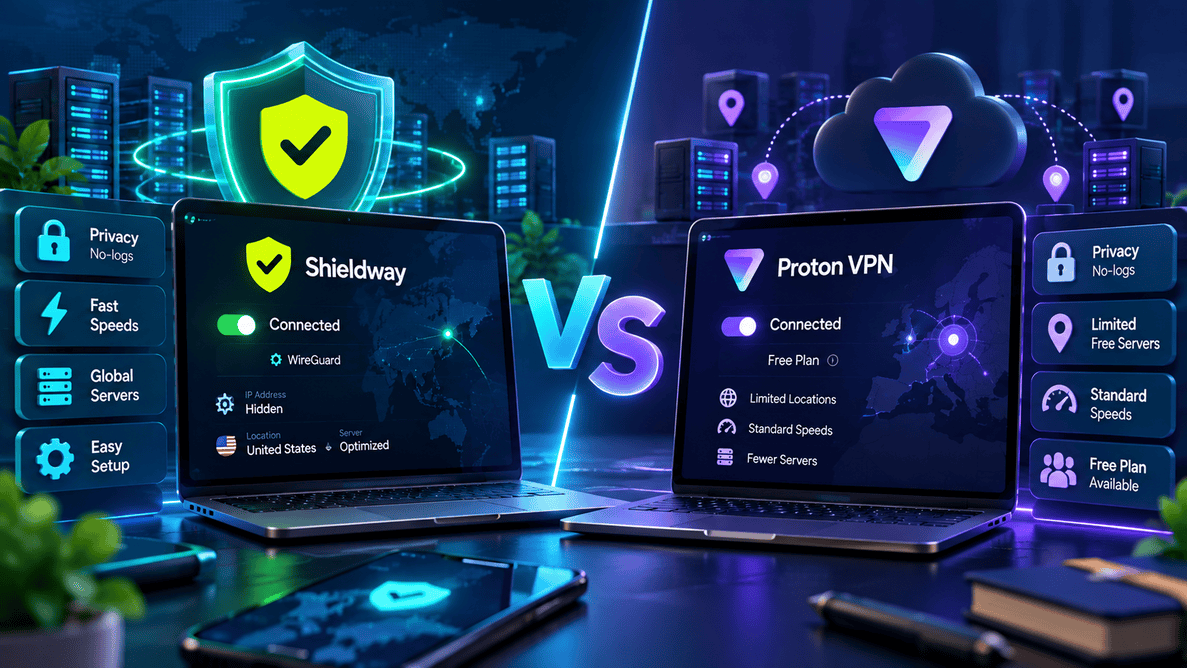
Shieldway and Proton VPN take different approaches to free access. Shieldway’s free model requires ByteConnect bandwidth sharing, while Proton VPN offers a free option with its own plan-specific restrictions and features. This makes the terms of access one of the most important differences to examine.
Comparison point | Shieldway | Proton VPN |
|---|---|---|
Connection approach | Managed WireGuard VPN | Supports multiple VPN protocols, depending on platform and settings |
Free access | Requires ByteConnect bandwidth sharing | Offers a no cost plan |
Privacy documentation | Published no-logs policy; no independent audit claimed yet | Review its current privacy policy and audit documentation |
Best reason to compare | Desktop access without running your own server | Free access and a broader range of plan options |
Verdict: Shieldway is a great alternative to investigate if you prefer its desktop approach and accept its bandwidth-sharing model. Proton VPN may be a better fit if you want a free plan that does not require this particular arrangement. Neither should be declared universally better without matching the comparison to your needs.
2. NordVPN: Best for Premium Security Features
NordVPN is a strong candidate if you are willing to pay for a premium VPN and want a broad selection of security and connection features. It is not a like-for-like replacement for a free VPN, so its value depends on whether the additional features justify the subscription for you.
NordVPN’s official feature page lists a kill switch and Double VPN on supported apps. Double VPN routes traffic through two VPN servers rather than one. That adds another hop, which can increase latency or reduce speed, so it is a specialised option rather than a default requirement for everyday browsing.
Who Is NordVPN Best For?
NordVPN is worth comparing if you frequently travel, want a range of server locations, use streaming services, or prefer a paid VPN with multiple connection and privacy options. Its features and server availability should be checked against your particular device and location.
If your priority is a permanent free VPN connection, NordVPN is not a like-for-like option; it is primarily a paid service. Check its official pricing page for current subscription and renewal terms before deciding whether the extra features justify the cost.
Double VPN and Other Premium VPN Features
The main advantage is its feature set, including Double VPN and other tools available on eligible plans and platforms. For users who want more control over their VPN connection, these options may be useful. NordVPN also offers applications for common desktop and mobile platforms, including Android.
The trade-off is the subscription cost. NordVPN offers monthly, one-year, and two-year subscription periods, and prices vary by plan and promotion; check its official pricing page for the current total and renewal terms. A premium VPN is not automatically better for every task, and no VPN makes you completely anonymous: websites can still identify you through accounts, cookies, browser fingerprints, and information you provide.
NordVPN vs. Proton VPN: Which Is Better?
NordVPN may be the better fit if its premium features match your requirements; Proton VPN is worth considering if its free plan or privacy-focused approach better matches your priorities. Compare the current plan details, supported protocols, server availability, privacy documentation, and subscription terms instead of choosing solely by brand reputation.
According to Proton’s official documentation, Secure Core routes traffic through hardened servers before it reaches the exit server, while Stealth is designed to make VPN traffic harder to detect in certain network environments. Availability depends on the provider's current apps and supported platforms. These are specific features to compare rather than proof that one provider is always better than another.
If you want features such as Double VPN, check how they work on your specific device. If you mainly want ordinary browsing privacy on public Wi-Fi, a well-configured VPN with appropriate encryption may be sufficient without using every advanced feature.
3. Surfshark: Best Value for Multiple Devices
Surfshark is worth considering if you want a paid VPN across multiple devices. Its published policy allows unlimited simultaneous device connections, while subscription bundles and prices vary. Compare the current plans, renewal rate, and included features rather than relying on the monthly equivalent in a promotional banner.
Surfshark’s official features page lists more than 4,500 servers in 100 countries and unlimited simultaneous device connections. Those are provider-published specifications, not independently measured performance results. App availability and individual features can vary by platform, so check the page for the devices you use.
Who Should Use Surfshark?
Surfshark is most relevant to users who prefer a paid VPN and want to compare the overall cost of protecting several devices. Its published features include unlimited simultaneous connections and more than 4,500 servers in 100 countries. It may be a good fit for households or individuals who use multiple operating systems and would rather manage their VPN connections through one provider.
It is less suitable if your non-negotiable requirement is a permanent free plan. In that case, Proton VPN and Shieldway’s conditional free access are more directly relevant comparisons, although their free-service models are different.
Surfshark vs. Proton VPN: Cost and Features
The main attraction is the ability to cover multiple devices under one subscription. Surfshark’s trust center lists third-party no-logs assurance work by Deloitte and infrastructure assessments. These reports have defined scopes; they should not be interpreted as an audit of every possible security risk or as a guarantee of future performance.
Surfshark’s pricing page displayed a Starter promotion equivalent to $2.49 per month when checked on 11 October 2026; the page showed a $67.23 promotional total for the first 27 months, with VAT potentially applying. Currency, offers, and renewal prices can differ. Treat that as a dated promotional example, not a guaranteed long-term rate. Compare the amount charged upfront and the renewal terms before buying.
Surfshark is worth comparing for paid-plan value and multi-device use, while Proton VPN is particularly relevant if you want to assess free access alongside paid features. Neither provider is automatically the best choice for every user; the result depends on device requirements, price, preferred features, and the provider’s current terms.
How We Test and Rate the Best Free VPNs
We evaluate VPN services by examining privacy, security, speed, streaming compatibility, ease of use, and value for money. These criteria help readers compare Shieldway, NordVPN, Surfshark, and Proton VPN according to their needs instead of assuming that the most expensive VPN is automatically the best.
For this article, we distinguish published product information and provider claims from independently verified results. We have not conducted a new, controlled hands-on test of all four services for this comparison, so we do not claim to have measured their relative speeds or personally verified streaming performance.
Privacy and Security
We examine each VPN provider’s privacy policy, logging claims, data-sharing practices, encryption, supported VPN protocols, and security features such as a kill switch. We also look for independent audits and distinguish verified findings from claims made by the provider itself.
This distinction is particularly important when evaluating a free VPN. For example, Shieldway’s free access involves ByteConnect bandwidth sharing, so its associated data processing needs to be considered separately from its claims about VPN browsing activity.
Speed, Free Servers, and Streaming

A VPN can affect connection speed because traffic passes through an additional server. A rigorous speed test should measure download speed, upload speed, latency, and connection stability using the same internet connection, locations, devices, and testing conditions. Measurements should be repeated with and without the VPN to understand the difference.
Without comparable measurements, it would be misleading to say that one provider is faster than Proton VPN or to assign a speed ranking based on assumptions. Server distance, congestion, the user’s internet connection, and the selected VPN protocol can all affect performance.
We also consider whether a VPN supports the devices and locations readers need, along with its advertised server coverage and streaming capabilities. Because streaming platforms regularly change how they detect VPN connections, compatibility should be checked against specific services rather than assumed from a provider’s marketing claims.
Free Plans, Paid Plans, and Overall Value
We compare free-plan restrictions, subscription costs, renewal terms, and the features available at each price level. We also examine any additional conditions attached to free access.
A free plan is not necessarily the best value for every user, just as a premium VPN is not automatically worth its price. The comparison should account for the service’s limitations, the features a user actually needs, and any requirements associated with continued access.
How We Interpret the Results
Our recommendations reflect the intended use case and the available evidence. We distinguish published specifications and provider claims from independently verified findings. Where direct testing has not been conducted, we avoid presenting estimated performance as measured results.
This approach helps readers compare VPNs more transparently and understand the limitations of a recommendation before making a decision.
How Do These VPN Alternatives Compare?
The best VPN depends on what you value most: Shieldway offers a WireGuard-based desktop option with conditional free access, NordVPN focuses on premium features, and Surfshark is worth comparing for paid-plan value. Proton VPN remains a relevant benchmark, particularly if you want to compare free access against subscription options.
Feature | Shieldway | NordVPN | Surfshark | Proton VPN |
|---|---|---|---|---|
Free option | Yes, with bandwidth sharing | No permanent free plan advertised | No permanent free plan advertised | Yes |
WireGuard | Yes | NordLynx is based on WireGuard | Supports WireGuard | Supports WireGuard |
Simultaneous devices | Check current free-plan terms | Depends on subscription | Unlimited connections | Free plan: 1 connection |
Advanced paid features | Check current plan details | Broad feature set | Broad feature set | Features vary by plan |
Streaming | Verify for your services | Verify for your services | Verify for your services | Verify for your services |
Main consideration | ByteConnect requirements | Subscription cost | Renewal price and plan terms | Free-plan limitations |
This comparison focuses on product positioning, not measured performance. We have not independently tested connection speeds, streaming access, or latency, so it would be misleading to rank these providers by speed or claim that one is faster than Proton VPN without comparable test results.
What Do VPN Usage Statistics Tell Us?
A small number of clearly attributed statistics helps explain the context for choosing a VPN, but none should be treated as evidence that one provider is best.
36% of UK businesses used a VPN for staff connecting remotely in the UK Government’s Cyber Security Breaches Survey 2025/2026, up from 31% in 2024/2025. The survey was published on 30 April 2026.
43% of UK businesses reported a cyber security breach or attack in the previous 12 months in that same survey. This is a broad cybersecurity measure; it does not show that a VPN would have prevented those incidents.
Around 50% of VPN users use only free VPN services, according to Surfshark’s VPN usage research. This is an estimate published by a VPN company, not a universal rate for every country.
13% of online adults in Pew Research Center’s 2017 cybersecurity knowledge survey knew that a VPN could help minimise risks from insecure Wi-Fi. This is a historical awareness result, not a current estimate.
12.04% average VPN adoption in 2025 was reported across 106 countries in Cybernews’ VPN adoption analysis. This is the study’s estimated adoption rate, not the percentage of all people worldwide who use a VPN.
About 412 million VPN app downloads in 2025 were recorded in the same Cybernews dataset. Downloads are not the same as unique users because one person may download an app more than once or install several VPN apps.
The figures have different populations, dates, and methods, so they should not be compared as if they measured the same thing. They provide context for VPN use and awareness, not a ranking of the providers reviewed here.
Are Free VPNs Safe, and How Do Free VPNs Make Money?

Some no-cost VPNs can be useful, but safety depends on the provider’s encryption, privacy practices, permissions, and business model—not simply whether the app costs nothing. A free VPN can protect a connection, but you should understand what data the service processes and what limitations apply before trusting it with your traffic.
Proton VPN’s free plan includes unlimited data and no ads, but limits users to one active VPN connection and servers in 10 countries. It is one of the more clearly documented free options, while Shieldway may be a great alternative to Proton VPN for desktop users who prefer managed WireGuard access and accept ByteConnect bandwidth sharing. Before you connect to the VPN, check the provider’s privacy policy, data-sharing practices, and plan restrictions: a free label alone does not establish whether a service is suitable for you.
The US Federal Trade Commission’s guidance on VPN apps explains that a VPN app can intercept internet traffic and cites research examining almost 300 VPN apps, some of which had security or privacy problems, including data sharing. The research is not a current audit of every VPN on the market, but the advice remains useful: check permissions, privacy policies, and independent evidence before installing an app.
How Do Free VPNs Make Money?
Free VPNs can be funded by paid upgrades, advertising, partnerships, or other business arrangements. Proton says its free VPN is funded by revenue from paid plans, while Shieldway conditions free access on ByteConnect bandwidth sharing. These are two different models: compare the provider’s explanation and privacy terms rather than assuming every free VPN makes money in the same way.
Shieldway’s model deserves particular attention because free VPN access requires ByteConnect bandwidth sharing. Review Shieldway’s download page and No-Logs Policy to understand the condition and the separate categories of data processing. This is a service-specific arrangement, not a description of how all free VPNs work.
Before installing free VPN apps, ask these questions:
Does the provider clearly explain what it logs?
Does it disclose third-party data sharing?
Are the security features and supported platforms documented?
Is there independent audit evidence, and what exactly did it cover?
Does the free plan have data caps, server restrictions, or other conditions?
A secure VPN should help protect the connection, but it does not eliminate tracking from every source. Websites may still recognise your account, cookies, or browser fingerprint, and a VPN does not replace antivirus software, strong passwords, or multi-factor authentication.
Many free VPNs don’t provide the same range of features as premium plans. However, a free tier can still be useful if it meets your needs. The key is to understand what the provider offers and what it expects in return.
How to Select the Best VPN for Your Needs
To select the best VPN, start with your actual requirements: free access, privacy, streaming, device support, or premium features. Then compare the relevant plans and policies rather than choosing based on a single ranking.
Use this checklist when comparing VPNs in 2026:
Decide whether you need a free or paid VPN. If you do not want a subscription, examine the free plan’s limitations and any conditions attached to access.
Review the privacy policy. Look for clear information about browsing logs, operational data, third parties, and independent audits.
Check security features. Encryption, secure VPN protocols, DNS handling, and a kill switch are worth investigating.
Confirm device support. Make sure the service works on your Windows, Mac, Android, or other devices.
Check streaming compatibility. Do not assume that every VPN server will work with Netflix or other streaming media services.
Compare total cost. Look beyond the introductory offer and review the renewal price, billing period, and cancellation terms.
Understand the trade-offs. For example, Shieldway’s free access requires ByteConnect bandwidth sharing, while premium services generally require payment.
If you need a VPN for routine browsing, you may not need every premium feature on the market. If you need a particular server location or advanced configuration, those requirements should guide your choice.
A VPN that supports the devices you use and provides clear privacy documentation may be a better fit than a service with more features that you will never use. Some users may also want to investigate specialist configurations such as onion over VPN, but they should understand the additional routing and performance trade-offs before enabling them.
Frequently Asked Questions
Choosing the right Proton VPN alternative depends on your budget, privacy priorities, and the features you need. Below, we answer common questions about the best free VPNs, how Shieldway compares with Proton VPN, whether paid VPNs offer better value, and what to consider before switching providers.
Is there a better free VPN than Proton VPN?
There may be a better fit for your needs, but there is no single best free VPN for everyone. Proton VPN offers a free plan, while Shieldway provides free access subject to its ByteConnect bandwidth-sharing requirement. Compare the restrictions, privacy policies, supported platforms, and connection needs before choosing.
What is the best alternative to Proton VPN?
The best alternative depends on your priorities. Shieldway is worth investigating for managed WireGuard desktop connections, NordVPN for premium features, and Surfshark for paid-plan value. Proton VPN itself may remain the best fit if its free or paid plan already meets your requirements.
Can no-cost VPNs work with Netflix?
Some VPN services work with Netflix, but availability can change by provider, server, region, and time. Check current compatibility and remember that streaming platforms may restrict VPN connections. Do not rely on a general VPN ranking as a guarantee that a specific library will be accessible.
Does Proton VPN offer a generous free plan?
Proton VPN’s free plan includes unlimited data, servers in 10 countries, and one simultaneous connection, according to its published plan details. Whether that is generous depends on your requirements. Check the available server locations, supported features, and plan terms rather than assuming that a free plan will meet every need.
Is a paid VPN better than a free VPN?
A paid VPN may provide more features, server options, or flexibility, but it is not automatically better for every user. If a free service meets your requirements and has a trustworthy privacy policy, paying for features you do not need may offer little benefit.
Can I use Proton VPN and another VPN at the same time?
Running two VPN apps simultaneously can cause routing conflicts or connection problems. Some services provide specialised multi-hop configurations, but these are different from simply connecting two separate VPN applications. Check the provider’s instructions before attempting this setup.
Can Police Track You When You Use Proton VPN?
Proton VPN says it follows a no-logs policy, so it does not retain records of your VPN browsing activity. However, police may still identify users through other evidence, account information, or data obtained from websites. The outcome depends on the circumstances and applicable law. Read Proton VPN’s privacy policy for details.
Conclusion: Which Proton VPN Alternative Should You Choose?
Shieldway, NordVPN, and Surfshark each serve a different purpose, so the best Proton VPN alternative is the one whose features and business model suit your needs. Shieldway is worth considering if you want a managed WireGuard desktop connection and accept its ByteConnect bandwidth-sharing requirement. NordVPN is a premium option for users who want its additional features, while Surfshark is worth comparing for paid-plan value and multiple-device use.
Proton VPN should not be dismissed simply because alternatives exist. Its free plan may be sufficient, and a switch only makes sense if another provider solves a specific problem for you. Compared to Proton, another service may offer a more suitable combination of features, but claims that a provider is faster than Proton VPN or universally better should be supported by comparable evidence.
The most important things to remember:
Compare the free plans carefully: free access may come with different restrictions or requirements.
Read the privacy policy: understand both VPN activity logging and other operational data processing.
Do not assume paid means better: compare the features you will actually use.
Check streaming and device compatibility: these can vary and may change.
Verify the terms before signing up: especially subscription renewals and free-access conditions.
For more details about Shieldway, visit the official Shieldway website, review its features, read its No-Logs Policy, or browse Shieldway’s existing blog posts for additional VPN guidance.